Bad News for Pharmaceutical Companies about Spending Trends

For years now, the pharmaceutical industry has justified its prices and its profits by reminding us that their products eventually go off patent, and are then offered cheaply to people around the world in generic form. They warned us that the pipeline for new and innovative drugs is less and less promising, because so many major advances have already taken place. Skeptics retort that the pharmaceutical industry has been talking this way for decades, with no sign of their profits coming to an end.
But the pharmaceutical industry may finally be correct. And here is some more evidence to back up that claim. This comes from a study  published in October that looks at health care spending among Americans under age 65, receiving health insurance through their employers. The picture below shows a number of spending trends bouncing up and down over the last four years. But there in orange, steadily declining, is a line representing spending on prescription drugs. Such spending reached the point in 2011 that it rose less than the general rate of inflation.
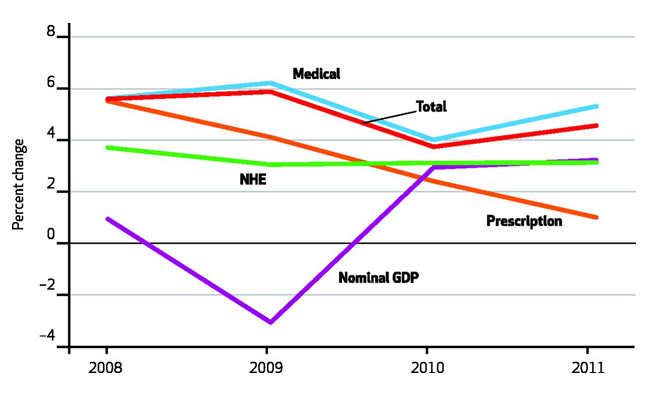
hc spending chartFour years might be a trend, but it is not an established pattern. Nevertheless, it is just the kind of evidence that brings plausibility to those in the pharmaceutical industry who say their best days are behind them.

Similar Posts

  • The Cost of New Cancer Drugs (In One Picture)

    “Specialty drugs” – that’s what they’re called. Not the pills of old, these pharmaceuticals are often given intravenously or through injection. Often more biologic in their synthesis than chemical, they are expensive to produce and often target narrow disease processes, meaning the number of patients likely to benefit from them is much much smaller than,…

  • The Biggest Government Health Care Spender Since LBJ Was…Ronald Reagan?

    Many readers will recognize Ronald Reagan’s famous maxim that: “Government is not the solution to our problem; government is the problem.”  Some will even recognize his vehement opposition to Lyndon Johnson’s Medicare proposal, before the program was passed into law: “We are faced with the most evil enemy mankind has known in his long climb…

  • 150,000 Walt Disney Employees Denied Mental Health Coverage – A Headline from the Future

    Newswire Services, April 11, 2015: Breaking News


    Since purchasing the Walt Disney Company six months ago, the Church of Scientologyhas been slowly remaking that venerable institution, in an effort to promote their ambitious religious mission. In the pipeline are an unprecedented number of science fiction films and John Travolta/Tom Cruise buddy movies, changes that have been surprisingly popular among movie fans.
    But now the church is making a change that is not so popular. It has decided that Disney employees will no longer receive insurance coverage for psychiatric care or any medications used to treat mental illness: “Psychiatrists are the enemy of the people,” stated Church spokesperson Walter McGee. “The church opposes their brutal, inhumane treatments and refuses to pay for such services because they collide with our religious beliefs.”
    Many Disney employees are up in arms over this decision. But the church is unrelenting in its position: “If people want to receive devil-care, they can either pay their own money or find a job somewhere else,” said McGee.
    Critics blame the situation on a decision made by President Obama in February of 2012. Early that month, he had announced regulations that would require health insurance companies to cover contraception, with exceptions for churches that oppose birth control but not for larger church run organizations such as hospitals or universities. The Roman Catholic Church cried foul, claiming that their religious freedom was being violated. In response to pressure, the Obama administration quickly backed off on its policy, broadening the religious exception to any church owned business that was run as part of the church’s broader religious mission.
    That shift in policy opened an opportunity for religious organizations to carve a broader set of services out of their health insurance plans. The Jehovah’s Witnesses had gained ownership of Wal-Mart in late 2013, and soon employees of that company (at least the ones who get health insurance) no longer received coverage for blood transfusions. An Orthodox Jewish organization became majority owners of Ace Hardware in early 2014, and now employees of that company no longer receive insurance coverage for insulin products that are derived from pork.
    The Church of Scientology is undeterred by critics who claim that treatments like antipsychotic medications and antidepressants ought to be part of any basic health insurance plan. “America is the land of religious freedom,” he explains “a place where the government has no right to stand between a church and its employees.”
    Who could argue with that logic?

Leave a Reply