Broken Democracy

Until recently, the state of North Carolina, where I live, was a bastion of political moderation, especially compared to our neighbors in the southeast. Our politics were moderate in part because the Democratic Party remained relatively strong in the state, and to survive in this region of the country had embraced center left, rather than the far left. Our politics were also moderate because of the influx of Northerners, arriving to places like the Raleigh Durham area where I live. As a result of this moderation, we developed high-tech industry corridors, provided excellent funding to our educational system, and became a pretty darn nice place to live.
This past year, Republicans took control of state government, and did not exactly pursue an agenda of political moderation. Moreover, this swing to the right was not justified by the political beliefs of the North Carolina population. Instead, a decent amount of the Republican’s political power resulted from gerrymandering, after the 2010 census. To get a sense of that, take a look at this figure from Mother Jones.
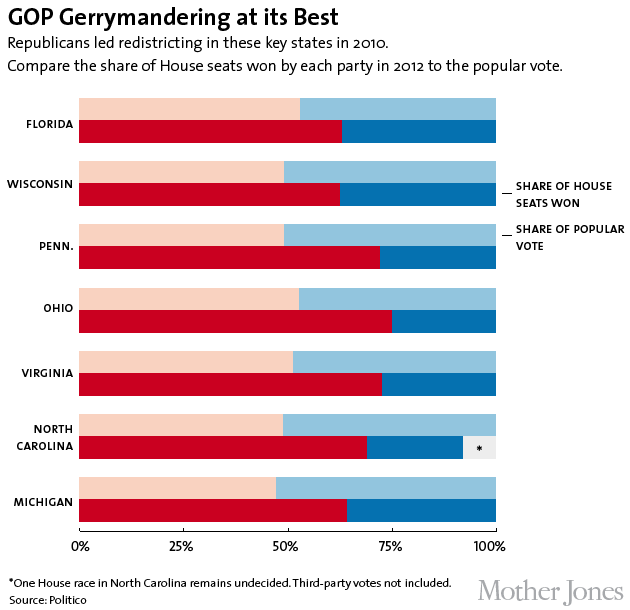
 GOP gerrymandering

I am not a fan of gerrymandering, no matter what political party this practice benefits. Our elected officials ought to mirror the political allegiance of our population. And as a flaming moderate, politically speaking, I’m especially worried that gerrymandering is contributing to the increasing polarization of our population.
We really ought to give the job of political redistricting to nonpartisan commissions. Our democracy deserves better than this!
(Click here to view comments)

Similar Posts

  • Great Writing, But Not by the Author of the New Thomas Jefferson Biography

    Jon Meacham’s best-selling biography, Thomas Jefferson: The Art of Power, is at best a solid read, presenting the basic facts of Jefferson’s life competently but with little grace and an almost invisible point of view. Perhaps I have been spoiled by Robert Caro’s amazing series of books on Lyndon Johnson, four volumes so far that not only make Johnson come to life (his ruthless genius as well as his fascinating contradictions) but also illuminate a whole era in U.S. history, all the while enveloping readers in gloriously rhythmic paragraphs. It is not fair, perhaps, to compare any biographer to Caro. Meacham’s book, after all, is just a single volume, so it cannot explore Jefferson in the same depth that Caro portrays Johnson. Meacham also had the disadvantage of writing about a man who lived a couple hundred years ago, whereas Caro could interview people who knew the subject of his biography firsthand. In addition, Meacham is a busy man, running a publishing company and appearing on television shows, whereas Caro lives the life of an obsessive, dedicating the better part of his adult life to understanding the ins and outs of Johnson’s life.
    Nevertheless, if you are going to write a book about an American president and subtitle it “The Art of Power,” you better expect some Caro comparisons.
    As it turns out, however, being compared to Caro is the least of Meacham’s writerly problems. Because there is another great writer that readers won’t be able to ignore when making their way through Meacham’s book. That writer, of course, is Thomas Jefferson.
    I’m going to give you a sprinkling of Jefferson’s prose in a bit, and follow-up later this week with several other great Jefferson quotes. But first, a little bit more on Meacham’s book. I was really disappointed, because in Meacham’s hands, Jefferson rarely comes alive on the page. Time passes by and suddenly the reader realizes: “Jefferson just became governor of Virginia? Was that something he was trying to accomplish? Which of the arts of power did he employ to reach that position?” Meacham never provides answers to these kinds of questions.

  • Why I Read

    I read for lots of reasons, of course. For entertainment. For information. For intellectual stimulation. To fill up a rainy day, since I can’t play piano for eight hours at a time. But another reason to read is to make me a better writer. In a wonderful essay in the Atlantic monthly, Richard Bausch makes…

  • The First War the United States Didn't Have to Fight

    The war of 1812 was sometimes called “Madison’s war” by those who opposed the President’s call for military action against Great Britain. A whole slew of grievances was building up between the two countries, especially with Britain’s bullying behavior in the seas. But it was also clear that Pres. Madison was itching for war, and…

Leave a Reply