How "Vague" Writing Can Be Powerful: A Lesson from Abe Lincoln
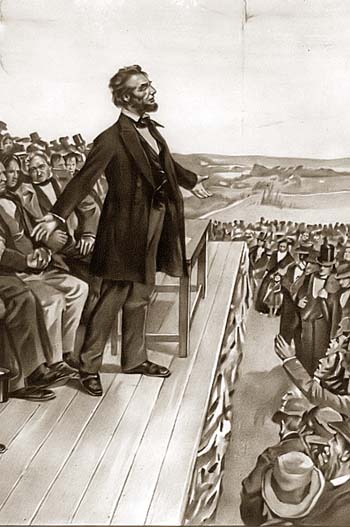
In his wonderful 1992 book – Lincoln at Gettysburg – Gary Wills explains that one of the reasons the Gettysburg address was so powerful is that Lincoln did not use any proper names – that’s right any – in the entire address. Consider this portion of the speech:

Now we are engaged in a great civil war, testing whether that nation, or any nation so conceived and so dedicated, can long endure. We are met on a great battlefield of that war. We have come to dedicate a portion of that field…

Not the Civil War but a civil war. Not the United States, but “that nation.” What’s the name of that battlefield? You won’t find that out by reading Lincoln’s speech. By being so nonspecific, so general, Lincoln made the message of his speech that much more universal. This is a writing lesson to keep in mind. Normally being more specific and more concrete makes writing more powerful. In this case, Lincoln found a better way to get his ideas across.
(Click here to view comments)

Similar Posts

  • Offensive Statements about Progressives from David Brooks of the New York Times

    David Brooks is a pretty solidly moderate conservative, and one who is a big fan of behavioral science. But that doesn’t mean he can see beyond his own biases, especially when describing the differences between conservatives and liberals. He was particularly offensive on May 7, in an article titled “Beyond the Fence,” in which he discusses…

  • Great Writing, But Not by the Author of the New Thomas Jefferson Biography

    Jon Meacham’s best-selling biography, Thomas Jefferson: The Art of Power, is at best a solid read, presenting the basic facts of Jefferson’s life competently but with little grace and an almost invisible point of view. Perhaps I have been spoiled by Robert Caro’s amazing series of books on Lyndon Johnson, four volumes so far that not only make Johnson come to life (his ruthless genius as well as his fascinating contradictions) but also illuminate a whole era in U.S. history, all the while enveloping readers in gloriously rhythmic paragraphs. It is not fair, perhaps, to compare any biographer to Caro. Meacham’s book, after all, is just a single volume, so it cannot explore Jefferson in the same depth that Caro portrays Johnson. Meacham also had the disadvantage of writing about a man who lived a couple hundred years ago, whereas Caro could interview people who knew the subject of his biography firsthand. In addition, Meacham is a busy man, running a publishing company and appearing on television shows, whereas Caro lives the life of an obsessive, dedicating the better part of his adult life to understanding the ins and outs of Johnson’s life.
    Nevertheless, if you are going to write a book about an American president and subtitle it “The Art of Power,” you better expect some Caro comparisons.
    As it turns out, however, being compared to Caro is the least of Meacham’s writerly problems. Because there is another great writer that readers won’t be able to ignore when making their way through Meacham’s book. That writer, of course, is Thomas Jefferson.
    I’m going to give you a sprinkling of Jefferson’s prose in a bit, and follow-up later this week with several other great Jefferson quotes. But first, a little bit more on Meacham’s book. I was really disappointed, because in Meacham’s hands, Jefferson rarely comes alive on the page. Time passes by and suddenly the reader realizes: “Jefferson just became governor of Virginia? Was that something he was trying to accomplish? Which of the arts of power did he employ to reach that position?” Meacham never provides answers to these kinds of questions.

Leave a Reply