Finally: Something Republicans and Democrats Can Agree On

The United States Medicare program is forbidden, by law, from negotiating with pharmaceutical companies. This was part of a negotiation that was reached at the time that the government, under the leadership of George W. Bush, created Medicare Part D, to cover prescription benefits for Medicare recipients. The pharmaceutical industry was quite worried that government involvement in prescription coverage would lead to price-fixing. So they lobbied for language that would forbid such actions, and that would even limit the government from negotiating prices with Pharma companies.
The US public doesn’t support that policy. According to a Kaiser Family Foundation poll, the vast majority of people – Democrats, independents and Republicans – want to see such negotiations:
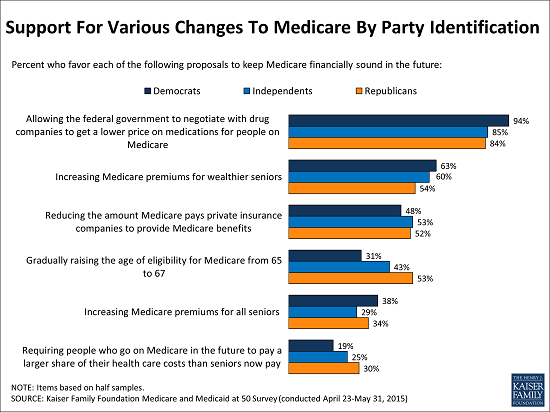
Finally Something Reps and Dems Can Agree On
Now we will see who our elected representatives actually represent!
 

Similar Posts

  • The Pill, the Pox and the Limits of Religious Freedom

    300 million dead worldwide from smallpox in the 20th century alone.  No wonder the United States Public HealthService is run by a General—fighting infectious disease was a life or death battle back then, and countries that failed to mobilize against the enemy would leave millions dead on the battlefield. In Germany, as I discussed in a recent…

  • The Era of Mega-Hospitals Has Arrived

    The Affordable Care Act, a.k.a. Obamacare, encourages healthcare providers to join together in what are called Accountable Care Organizations. Prior to the passage of Obamacare, hospitals were already pursuing mergers, in an effort to gain market share and have better negotiating ability with insurance companies. That trend looks like it has accelerated since the passage…

  • Is the Nutritional Supplement Industry Feeding You Bull Balls for Breakfast?

    My patient had been feeling unusually irritable lately.  Nothing had changed in his home or work life to bring on such a shift in mood.  He wasn’t taking any medicines that could cause such symptoms either, being a strappingly healthy young guy.  A weightlifter in fact.  “Are you taking any kind of steroids?,” I asked…

  • 150,000 Walt Disney Employees Denied Mental Health Coverage – A Headline from the Future

    Newswire Services, April 11, 2015: Breaking News


    Since purchasing the Walt Disney Company six months ago, the Church of Scientologyhas been slowly remaking that venerable institution, in an effort to promote their ambitious religious mission. In the pipeline are an unprecedented number of science fiction films and John Travolta/Tom Cruise buddy movies, changes that have been surprisingly popular among movie fans.
    But now the church is making a change that is not so popular. It has decided that Disney employees will no longer receive insurance coverage for psychiatric care or any medications used to treat mental illness: “Psychiatrists are the enemy of the people,” stated Church spokesperson Walter McGee. “The church opposes their brutal, inhumane treatments and refuses to pay for such services because they collide with our religious beliefs.”
    Many Disney employees are up in arms over this decision. But the church is unrelenting in its position: “If people want to receive devil-care, they can either pay their own money or find a job somewhere else,” said McGee.
    Critics blame the situation on a decision made by President Obama in February of 2012. Early that month, he had announced regulations that would require health insurance companies to cover contraception, with exceptions for churches that oppose birth control but not for larger church run organizations such as hospitals or universities. The Roman Catholic Church cried foul, claiming that their religious freedom was being violated. In response to pressure, the Obama administration quickly backed off on its policy, broadening the religious exception to any church owned business that was run as part of the church’s broader religious mission.
    That shift in policy opened an opportunity for religious organizations to carve a broader set of services out of their health insurance plans. The Jehovah’s Witnesses had gained ownership of Wal-Mart in late 2013, and soon employees of that company (at least the ones who get health insurance) no longer received coverage for blood transfusions. An Orthodox Jewish organization became majority owners of Ace Hardware in early 2014, and now employees of that company no longer receive insurance coverage for insulin products that are derived from pork.
    The Church of Scientology is undeterred by critics who claim that treatments like antipsychotic medications and antidepressants ought to be part of any basic health insurance plan. “America is the land of religious freedom,” he explains “a place where the government has no right to stand between a church and its employees.”
    Who could argue with that logic?

Leave a Reply