Health Insurance Exchanges in One Picture

Here is an excellent picture from the New England Journal of Medicine, illustrating which states have chosen to run their own exchanges, which are relying on the federal government, and which are following some kind of hybrid approach. Unsurprisingly, the distribution of states pretty closely mirrors the outcome of the most recent presidential election.
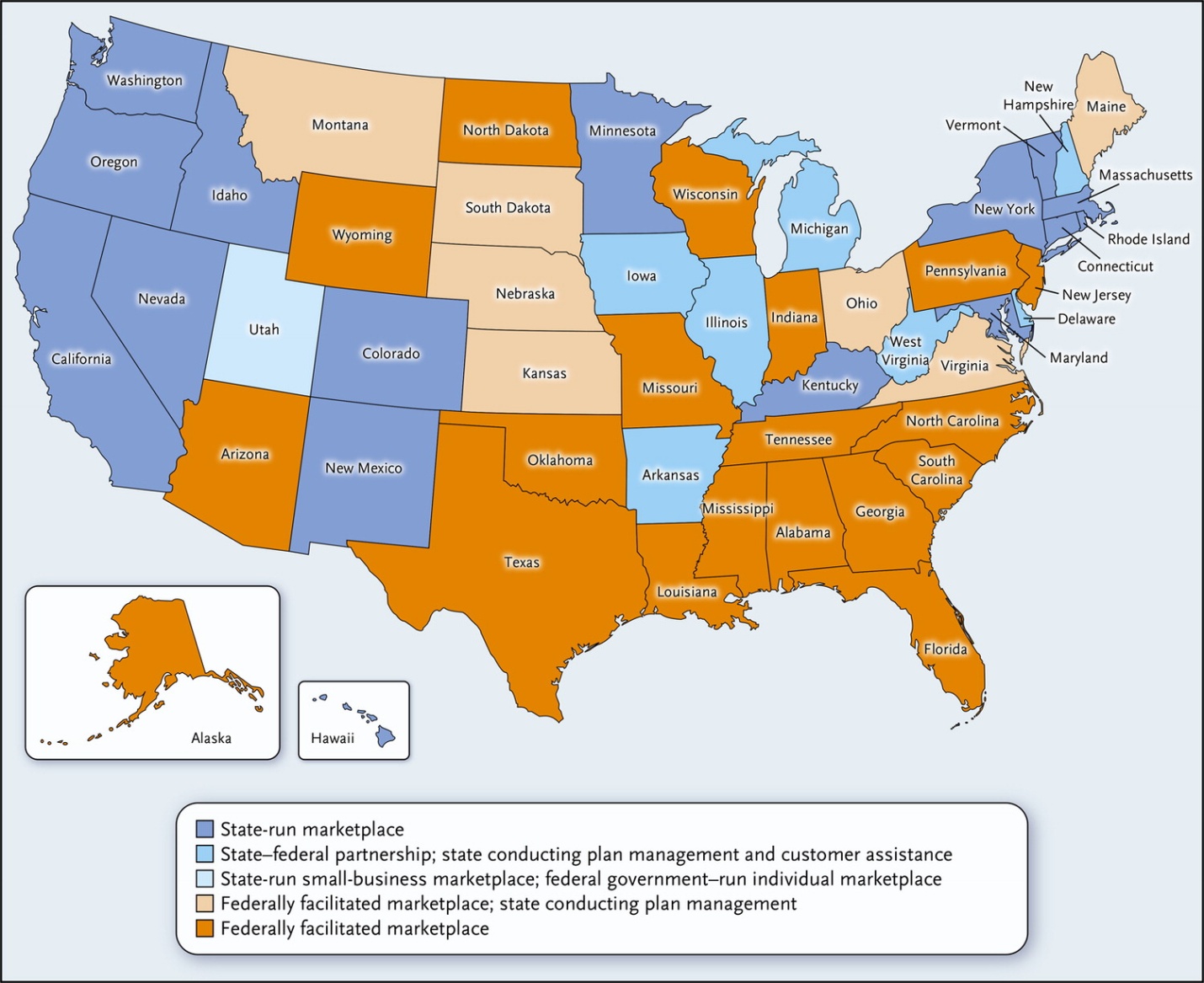
whos running exchanges
(Click here to view comments)

Similar Posts

  • 150,000 Walt Disney Employees Denied Mental Health Coverage – A Headline from the Future

    Newswire Services, April 11, 2015: Breaking News


    Since purchasing the Walt Disney Company six months ago, the Church of Scientologyhas been slowly remaking that venerable institution, in an effort to promote their ambitious religious mission. In the pipeline are an unprecedented number of science fiction films and John Travolta/Tom Cruise buddy movies, changes that have been surprisingly popular among movie fans.
    But now the church is making a change that is not so popular. It has decided that Disney employees will no longer receive insurance coverage for psychiatric care or any medications used to treat mental illness: “Psychiatrists are the enemy of the people,” stated Church spokesperson Walter McGee. “The church opposes their brutal, inhumane treatments and refuses to pay for such services because they collide with our religious beliefs.”
    Many Disney employees are up in arms over this decision. But the church is unrelenting in its position: “If people want to receive devil-care, they can either pay their own money or find a job somewhere else,” said McGee.
    Critics blame the situation on a decision made by President Obama in February of 2012. Early that month, he had announced regulations that would require health insurance companies to cover contraception, with exceptions for churches that oppose birth control but not for larger church run organizations such as hospitals or universities. The Roman Catholic Church cried foul, claiming that their religious freedom was being violated. In response to pressure, the Obama administration quickly backed off on its policy, broadening the religious exception to any church owned business that was run as part of the church’s broader religious mission.
    That shift in policy opened an opportunity for religious organizations to carve a broader set of services out of their health insurance plans. The Jehovah’s Witnesses had gained ownership of Wal-Mart in late 2013, and soon employees of that company (at least the ones who get health insurance) no longer received coverage for blood transfusions. An Orthodox Jewish organization became majority owners of Ace Hardware in early 2014, and now employees of that company no longer receive insurance coverage for insulin products that are derived from pork.
    The Church of Scientology is undeterred by critics who claim that treatments like antipsychotic medications and antidepressants ought to be part of any basic health insurance plan. “America is the land of religious freedom,” he explains “a place where the government has no right to stand between a church and its employees.”
    Who could argue with that logic?

  • Talking To Your Doctor About Out-Of-Pocket Costs Can Save You Money

    Healthcare is often really costly. And with increasing frequency, a significant chunk of those costs is being passed on to patients in the form of high deductibles, copays, or other out-of-pocket expenses. As a result, millions of Americans struggle to pay medical bills each year. What’s a poor patient to do? For starters–they can talk…

  • Reforming Not Only How We Pay Physicians, but How Much We Pay Them

    Any sensible plan to reform the U.S. health care system must reform the way we pay physicians. Currently, we reward doctors for doing more “stuff” for their patients — for performing tests and procedures whether or not these interventions are necessary. Because of this strange reimbursement system, many primary care physicians receive more money performing…

  • Toxic Side Effect: High Out-of-Pocket Health Care Costs

    When is the treatment worse than the disease? When the high costs associated with care become a financial burden for patients and in many cases prevent them from protecting their health, contends Peter Ubel, MD, a 2007 recipient of a Robert Wood Johnson Foundation (RWJF) Investigator Award in Health Policy Research. “We have reached a…

  • |

    Want to Reduce Opiate Overdoses? Legalize Medical Marijuana

    I have written about medical marijuana before, relaying research findings showing that the legalization of medical marijuana is associated with a reduction in use of pain medications. Here’s another piece of evidence leading to a similar conclusion, from a study by the research team of Bradford and Bradford out of the University of Georgia. (Athens,…

Leave a Reply