Jeremy Bentham Rejecting the Idea of Human Equality
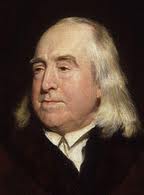
In many ways, Jeremy Bentham was all about equality. As the father of utilitarianism, he believed that all social policy should be designed to maximize the happiness and pleasures of humans’ experience while minimizing the pains and miseries. And in espousing this theory of justice, he didn’t distinguish between upper class and lower class and men or women. He strove for politics that maximized human happiness. Nevertheless, when he first read the Declaration of Independence, he scoffed at the idea that all men are created equal:

“’All men,’ they tell us, ‘are created equal.’ This surely is a new discovery; now, for the first time, we learn, that a child, at the moment of its birth, has the same quantity of natural power as the parent, the same quantity of political power as the magistrate.”

I guess Bentham missed the idea that when Thomas Jefferson wrote that all men are created equal, he meant equal in terms of the rights they hold in front of their governments.
(Click here to view comments)

Similar Posts

  • A Great Sentence from Brian Hiatt in Rolling Stone Magazine

    In an article about Natalie Maine, the former lead singer for The Dixie Chicks, Hiatt writes about the way her conservative, country fan base reacted when she spoke negatively about President George W. Bush. I thought it was worth sharing this sentence: It was as if she’d French-kissed Saddam Hussein while setting fire to a…

  • Why I Read

    I read for lots of reasons, of course. For entertainment. For information. For intellectual stimulation. To fill up a rainy day, since I can’t play piano for eight hours at a time. But another reason to read is to make me a better writer. In a wonderful essay in the Atlantic monthly, Richard Bausch makes…

  • Great Writing, But Not by the Author of the New Thomas Jefferson Biography

    Jon Meacham’s best-selling biography, Thomas Jefferson: The Art of Power, is at best a solid read, presenting the basic facts of Jefferson’s life competently but with little grace and an almost invisible point of view. Perhaps I have been spoiled by Robert Caro’s amazing series of books on Lyndon Johnson, four volumes so far that not only make Johnson come to life (his ruthless genius as well as his fascinating contradictions) but also illuminate a whole era in U.S. history, all the while enveloping readers in gloriously rhythmic paragraphs. It is not fair, perhaps, to compare any biographer to Caro. Meacham’s book, after all, is just a single volume, so it cannot explore Jefferson in the same depth that Caro portrays Johnson. Meacham also had the disadvantage of writing about a man who lived a couple hundred years ago, whereas Caro could interview people who knew the subject of his biography firsthand. In addition, Meacham is a busy man, running a publishing company and appearing on television shows, whereas Caro lives the life of an obsessive, dedicating the better part of his adult life to understanding the ins and outs of Johnson’s life.
    Nevertheless, if you are going to write a book about an American president and subtitle it “The Art of Power,” you better expect some Caro comparisons.
    As it turns out, however, being compared to Caro is the least of Meacham’s writerly problems. Because there is another great writer that readers won’t be able to ignore when making their way through Meacham’s book. That writer, of course, is Thomas Jefferson.
    I’m going to give you a sprinkling of Jefferson’s prose in a bit, and follow-up later this week with several other great Jefferson quotes. But first, a little bit more on Meacham’s book. I was really disappointed, because in Meacham’s hands, Jefferson rarely comes alive on the page. Time passes by and suddenly the reader realizes: “Jefferson just became governor of Virginia? Was that something he was trying to accomplish? Which of the arts of power did he employ to reach that position?” Meacham never provides answers to these kinds of questions.

Leave a Reply