Paul Samuelson's View of Milton Friedman
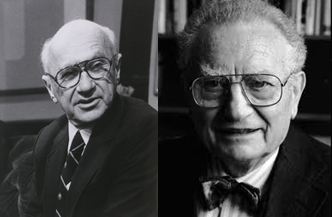
friedman_samuelsonIn their book Animal Spirits, George Akerlof and Robert Shiller recount the intellectual battles waged between Milton Friedman and Paul Samuelson, two of the 20th century’s most important economists. Friedman was a huge believer in the power of markets, and in consumers’abilities to make rational decisions. Samuelson also recognized the power of markets, but thought Friedman went too far. Akerlof and Shiller say that Samuelson described Friedman as:

Like the boy who knew how to spell banana but did not know when to stop.

And I will stop this post right here.
(Click here to view comments)

Similar Posts

  • The Secrets of Creativity?


    The best thing about bad art is that it makes fodder for great reviews. Take the opening line of Mina Strohminger’s review of Colin McGee’s “The Meaning of Disgust”: “In disgust research,” she writes in The Journal of Aesthetics and Critical Art, “there is shit, and then there is bullshit.”
    Guess which category she thinks McGee’s book falls under?
    read more
    View original post and comments at Scientocracy

  • Great Writing, But Not by the Author of the New Thomas Jefferson Biography

    Jon Meacham’s best-selling biography, Thomas Jefferson: The Art of Power, is at best a solid read, presenting the basic facts of Jefferson’s life competently but with little grace and an almost invisible point of view. Perhaps I have been spoiled by Robert Caro’s amazing series of books on Lyndon Johnson, four volumes so far that not only make Johnson come to life (his ruthless genius as well as his fascinating contradictions) but also illuminate a whole era in U.S. history, all the while enveloping readers in gloriously rhythmic paragraphs. It is not fair, perhaps, to compare any biographer to Caro. Meacham’s book, after all, is just a single volume, so it cannot explore Jefferson in the same depth that Caro portrays Johnson. Meacham also had the disadvantage of writing about a man who lived a couple hundred years ago, whereas Caro could interview people who knew the subject of his biography firsthand. In addition, Meacham is a busy man, running a publishing company and appearing on television shows, whereas Caro lives the life of an obsessive, dedicating the better part of his adult life to understanding the ins and outs of Johnson’s life.
    Nevertheless, if you are going to write a book about an American president and subtitle it “The Art of Power,” you better expect some Caro comparisons.
    As it turns out, however, being compared to Caro is the least of Meacham’s writerly problems. Because there is another great writer that readers won’t be able to ignore when making their way through Meacham’s book. That writer, of course, is Thomas Jefferson.
    I’m going to give you a sprinkling of Jefferson’s prose in a bit, and follow-up later this week with several other great Jefferson quotes. But first, a little bit more on Meacham’s book. I was really disappointed, because in Meacham’s hands, Jefferson rarely comes alive on the page. Time passes by and suddenly the reader realizes: “Jefferson just became governor of Virginia? Was that something he was trying to accomplish? Which of the arts of power did he employ to reach that position?” Meacham never provides answers to these kinds of questions.

  • Red Robin, Red Robin, Please Clog My Arteries!

    A while back, one of my favorite journalists – Sarah Kliff, from Vox – published a picture showing which chain restaurants win the award for offering the highest calorie entrées. I figured it was time to recirculate this gallery of infamy. Here is the Vox picture of these award winners: These are truly staggering sums….

Leave a Reply