The Rise of Government Spending: An International View

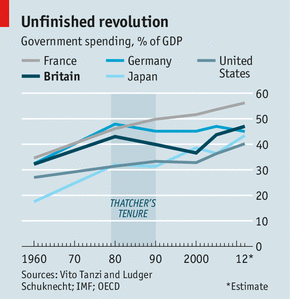
An article from The Economist last April explored Margaret Thatcher’s influence on government spending in Britain during her tenure as prime minister. The magazine published a very interesting graphic, showing the rise of government spending in five countries. I thought I would reproduce the picture for you here, because it illustrates some fascinating issues:
government spending

First, at the risk of being parochial, it is interesting to see that the United States is still on the lower end of government spending, compared to these other countries. Second, the long-term trend for all these countries points towards increased government spending, with stops and starts in some countries more than others, but with what looks like an inevitable uptick over time. That is a huge challenge for virtually every developed country on the planet.
And lest we, in United States, think we can brag about our relatively low government spending, remember that this figure illustrates spending as a percent of GDP. And the US has a higher GDP than these other countries. In terms of spending per capita, I doubt we are much better than any of these countries.
(Click here to view comments)

Similar Posts

  • Great Writing, But Not by the Author of the New Thomas Jefferson Biography

    Jon Meacham’s best-selling biography, Thomas Jefferson: The Art of Power, is at best a solid read, presenting the basic facts of Jefferson’s life competently but with little grace and an almost invisible point of view. Perhaps I have been spoiled by Robert Caro’s amazing series of books on Lyndon Johnson, four volumes so far that not only make Johnson come to life (his ruthless genius as well as his fascinating contradictions) but also illuminate a whole era in U.S. history, all the while enveloping readers in gloriously rhythmic paragraphs. It is not fair, perhaps, to compare any biographer to Caro. Meacham’s book, after all, is just a single volume, so it cannot explore Jefferson in the same depth that Caro portrays Johnson. Meacham also had the disadvantage of writing about a man who lived a couple hundred years ago, whereas Caro could interview people who knew the subject of his biography firsthand. In addition, Meacham is a busy man, running a publishing company and appearing on television shows, whereas Caro lives the life of an obsessive, dedicating the better part of his adult life to understanding the ins and outs of Johnson’s life.
    Nevertheless, if you are going to write a book about an American president and subtitle it “The Art of Power,” you better expect some Caro comparisons.
    As it turns out, however, being compared to Caro is the least of Meacham’s writerly problems. Because there is another great writer that readers won’t be able to ignore when making their way through Meacham’s book. That writer, of course, is Thomas Jefferson.
    I’m going to give you a sprinkling of Jefferson’s prose in a bit, and follow-up later this week with several other great Jefferson quotes. But first, a little bit more on Meacham’s book. I was really disappointed, because in Meacham’s hands, Jefferson rarely comes alive on the page. Time passes by and suddenly the reader realizes: “Jefferson just became governor of Virginia? Was that something he was trying to accomplish? Which of the arts of power did he employ to reach that position?” Meacham never provides answers to these kinds of questions.

  • The Power of Thresholds

    In a recent post, I reproduce the figure showing the “stickiness” of odometer readings, when it comes to the price of used cars. Much better to sell your car at 49,999 miles rather than 50,001 miles. But here’s another sticky threshold, that was reported on at 538.com. It shows that when airplane flights leave 40…

  • Why People Choose Boring Careers

    Fascinating new research sheds light on why so many people stick with dull jobs over trying something more exciting: They don’t expect to get paid enough to justify going after the more interesting options. Research into “effort aversion“ by Duke University Fuqua School of Business marketing professor Peter Ubel and David Comerford, an assistant professor at Stirling University found that in…

Leave a Reply