Abraham Lincoln Knew How to Milk a Metaphor
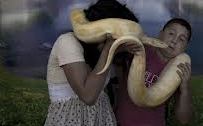
kid afraid of snakeI could go on quoting Abraham Lincoln all day long, for he was one of the finest writers of his or any time. Here’s one very special quote, where Lincoln uses the metaphor of a snake to make distinctions between slavery itself being bad, versus policies to limit slavery to the south, versus policies to prevent slavery from expanding into new US territories.

If I saw a venomous snake crawling in the road, any man would say I may seize the nearest stick and kill it. But if I found that snake in bed with my children that would be another question. I might hurt the children more than the snake, and it might bite them.

In other words, slavery is bad, but ending slavery in the South might harm unintended victims.

Much more, if I found it in bed with my neighbor’s children, and I had found myself by a solemn oath not to meddle with his children under any circumstances, it would become me to let that particular mode of getting rid of the gentleman alone.

In other words, once they signed on to the Constitution, Northerners became duty-bound to leave slavery alone in the south.

But if there was a bed newly made up, to which the children were to be taken, and it was proposed to take a batch of young snakes and put them there with them, I take it no man would say there was any question how I ought to decide.

And that is the reasoning by which Lincoln concluded that slavery should not be expanded into new territories, a position the south could not tolerate, because Southerners saw such a policy as the beginning of the end of slavery in their lands. What a brilliant way to frame the argument.
(Click here to view comments)

Similar Posts

  • On Healthy Soldiers

    In World War II, soldiers were reminded regularly to take their anti-malaria pills. One soldier summarized this practice as follows: “Like fat cattle who are pampered to the very doors of the slaughterhouse, it was important that if and when we died we should be in good health.” Gulp. (Click here to view comments)

  • Great Writing, But Not by the Author of the New Thomas Jefferson Biography

    Jon Meacham’s best-selling biography, Thomas Jefferson: The Art of Power, is at best a solid read, presenting the basic facts of Jefferson’s life competently but with little grace and an almost invisible point of view. Perhaps I have been spoiled by Robert Caro’s amazing series of books on Lyndon Johnson, four volumes so far that not only make Johnson come to life (his ruthless genius as well as his fascinating contradictions) but also illuminate a whole era in U.S. history, all the while enveloping readers in gloriously rhythmic paragraphs. It is not fair, perhaps, to compare any biographer to Caro. Meacham’s book, after all, is just a single volume, so it cannot explore Jefferson in the same depth that Caro portrays Johnson. Meacham also had the disadvantage of writing about a man who lived a couple hundred years ago, whereas Caro could interview people who knew the subject of his biography firsthand. In addition, Meacham is a busy man, running a publishing company and appearing on television shows, whereas Caro lives the life of an obsessive, dedicating the better part of his adult life to understanding the ins and outs of Johnson’s life.
    Nevertheless, if you are going to write a book about an American president and subtitle it “The Art of Power,” you better expect some Caro comparisons.
    As it turns out, however, being compared to Caro is the least of Meacham’s writerly problems. Because there is another great writer that readers won’t be able to ignore when making their way through Meacham’s book. That writer, of course, is Thomas Jefferson.
    I’m going to give you a sprinkling of Jefferson’s prose in a bit, and follow-up later this week with several other great Jefferson quotes. But first, a little bit more on Meacham’s book. I was really disappointed, because in Meacham’s hands, Jefferson rarely comes alive on the page. Time passes by and suddenly the reader realizes: “Jefferson just became governor of Virginia? Was that something he was trying to accomplish? Which of the arts of power did he employ to reach that position?” Meacham never provides answers to these kinds of questions.

Leave a Reply