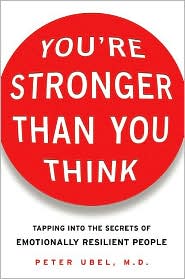
Why I Write Books

“I just finished reading your book You’re Stronger than You Think and felt compelled to write you. I found it tremendously enriching from both a personal and professional point of view.”
That was the opening sentence from a recent e-mail I received from a complete stranger. Truth be told, it is impossible to get too many e-mails like this!
The person who sent the e-mail went on to say: “I want to congratulate you on expressing such deep, important matters in an entertaining and simple way. Your book helped strengthen many of my beliefs and shed light on concrete ways in which we can life fulfilled lives. Please know that your work truly makes a difference and has been appreciated tremendously.”
I did not sell nearly as many copies of this book as I hoped to. I wanted my ideas to get out to more people. Many days, in fact, I feel a touch of sadness that the book hasn’t reached more people. But all that sadness goes away when I receive e-mails like this. This is why I write books. This is why I will keep on writing books, until the day I die.

Similar Posts

  • Great Writing, But Not by the Author of the New Thomas Jefferson Biography

    Jon Meacham’s best-selling biography, Thomas Jefferson: The Art of Power, is at best a solid read, presenting the basic facts of Jefferson’s life competently but with little grace and an almost invisible point of view. Perhaps I have been spoiled by Robert Caro’s amazing series of books on Lyndon Johnson, four volumes so far that not only make Johnson come to life (his ruthless genius as well as his fascinating contradictions) but also illuminate a whole era in U.S. history, all the while enveloping readers in gloriously rhythmic paragraphs. It is not fair, perhaps, to compare any biographer to Caro. Meacham’s book, after all, is just a single volume, so it cannot explore Jefferson in the same depth that Caro portrays Johnson. Meacham also had the disadvantage of writing about a man who lived a couple hundred years ago, whereas Caro could interview people who knew the subject of his biography firsthand. In addition, Meacham is a busy man, running a publishing company and appearing on television shows, whereas Caro lives the life of an obsessive, dedicating the better part of his adult life to understanding the ins and outs of Johnson’s life.
    Nevertheless, if you are going to write a book about an American president and subtitle it “The Art of Power,” you better expect some Caro comparisons.
    As it turns out, however, being compared to Caro is the least of Meacham’s writerly problems. Because there is another great writer that readers won’t be able to ignore when making their way through Meacham’s book. That writer, of course, is Thomas Jefferson.
    I’m going to give you a sprinkling of Jefferson’s prose in a bit, and follow-up later this week with several other great Jefferson quotes. But first, a little bit more on Meacham’s book. I was really disappointed, because in Meacham’s hands, Jefferson rarely comes alive on the page. Time passes by and suddenly the reader realizes: “Jefferson just became governor of Virginia? Was that something he was trying to accomplish? Which of the arts of power did he employ to reach that position?” Meacham never provides answers to these kinds of questions.

Leave a Reply