|

Spending More But Not Living Longer?

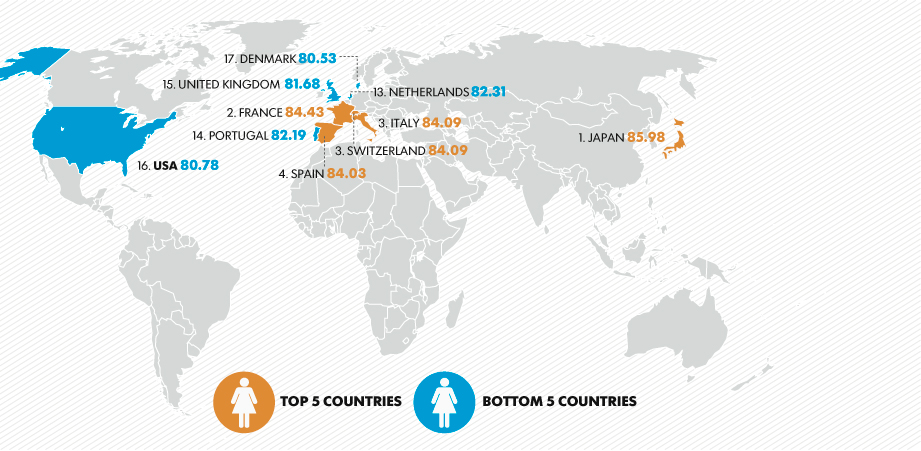
In a recent report from the IOM, the US comes in with surprisingly low life expectancy compared to other developed countries.  Take, for instance, this picture from USA Today, showing life expectancy for women:

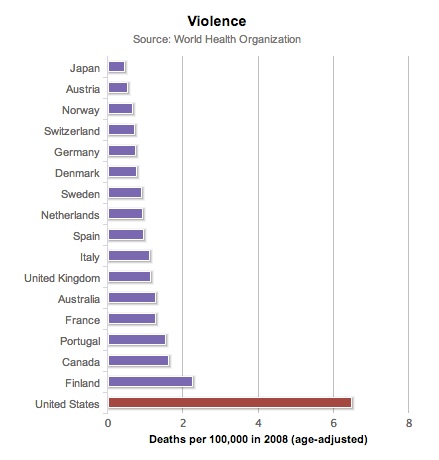
At the same time, we spend WAY MORE on health care than any of our peers.  No one is even a close second.  Does that mean our spending is not yielding appropriate results?  Those of you who follow my writing (I’m talking to BOTH of you) know that I have serious concerns about health care spending in the US.  But keep in mind, that life expectancy is a TERRIBLE measure of health care quality. Living longer is much more a function of broader social issues than it is a function of health care quality.  Consider this other comparison figure from the IOM report:

Yep.  The US is a dominant leader when it comes to the violent deaths of its population. Cannot blame that on the inefficiencies of for-profit hospitals or the administrative complexity of Medicare.
Living long and living well depends on a broad array of social factors, from neighborhood quality to income inequality.  If we want longer and better lives in the US, I wouldn’t look for the health care system to do the heavy lifting.

Similar Posts

  • Promoting Social Responsibility Among Pharmaceutical Companies

    Last fall, an article in the New England Journal presented a powerful picture of just how much effort different pharmaceutical companies make to give poor people access to their products. Here is the picture from that article: The captains of industry are a competitive group of people, I am told. They like to see where…

  • State Mandates Online Health Care Price

    The hospital price transparency bill that was signed into effect on August 21 has elicited criticism from the Duke health community. House Bill 834 mandates that hospitals and medical care agencies in North Carolina—including Duke University Medical Center—provide pricing information on 140 of the most common health care procedures to the Department of Health and…

  • You Know Who Else Fails 'The Jimmy Kimmel Test?' Hospital Emergency Rooms

    (Randy Holmes/ABC via Getty Images) When Jimmy Kimmel’s child was diagnosed with a serious heart condition, Kimmel realized that people without his wealth (or his generous insurance coverage) would not be able to pay for the life-saving care that his child received, if their children were to be similarly ill. So he gave a moving…

  • 150,000 Walt Disney Employees Denied Mental Health Coverage – A Headline from the Future

    Newswire Services, April 11, 2015: Breaking News


    Since purchasing the Walt Disney Company six months ago, the Church of Scientologyhas been slowly remaking that venerable institution, in an effort to promote their ambitious religious mission. In the pipeline are an unprecedented number of science fiction films and John Travolta/Tom Cruise buddy movies, changes that have been surprisingly popular among movie fans.
    But now the church is making a change that is not so popular. It has decided that Disney employees will no longer receive insurance coverage for psychiatric care or any medications used to treat mental illness: “Psychiatrists are the enemy of the people,” stated Church spokesperson Walter McGee. “The church opposes their brutal, inhumane treatments and refuses to pay for such services because they collide with our religious beliefs.”
    Many Disney employees are up in arms over this decision. But the church is unrelenting in its position: “If people want to receive devil-care, they can either pay their own money or find a job somewhere else,” said McGee.
    Critics blame the situation on a decision made by President Obama in February of 2012. Early that month, he had announced regulations that would require health insurance companies to cover contraception, with exceptions for churches that oppose birth control but not for larger church run organizations such as hospitals or universities. The Roman Catholic Church cried foul, claiming that their religious freedom was being violated. In response to pressure, the Obama administration quickly backed off on its policy, broadening the religious exception to any church owned business that was run as part of the church’s broader religious mission.
    That shift in policy opened an opportunity for religious organizations to carve a broader set of services out of their health insurance plans. The Jehovah’s Witnesses had gained ownership of Wal-Mart in late 2013, and soon employees of that company (at least the ones who get health insurance) no longer received coverage for blood transfusions. An Orthodox Jewish organization became majority owners of Ace Hardware in early 2014, and now employees of that company no longer receive insurance coverage for insulin products that are derived from pork.
    The Church of Scientology is undeterred by critics who claim that treatments like antipsychotic medications and antidepressants ought to be part of any basic health insurance plan. “America is the land of religious freedom,” he explains “a place where the government has no right to stand between a church and its employees.”
    Who could argue with that logic?

  • |

    Medicare Costs and the Income Trap

    Paying Doctors Less Is the Key to Better Coverage Conservatives propose to control healthcare costs by bringing the discipline of the free market to bear upon the healthcare system. Some progressive groups advocate controlling costs with a more interventionist plan. But neither approach, as far as I have seen, adequately confronts one of the biggest…

Leave a Reply